As Starcasm was the first to report, Love under lockup and Life after lockup star LaTisha Collier tries to get out of a plea agreement she agreed in April where she pleaded guilty to theft and forgery.
In addition to pleading guilty to the charges, LaTisha also acknowledged that she would be sentenced as a habitual offender due to her previous felony convictions. The habitual offender enhancement meant LaTisha faced at least three years in prison before he was eligible for parole.
In LaTisha’s motion to vacate the plea deal, she argued that she felt pressure because of a pending trial date for one of the cases. She also had “growing concerns about the strength of the state’s evidence and the credibility issues surrounding key witnesses.”
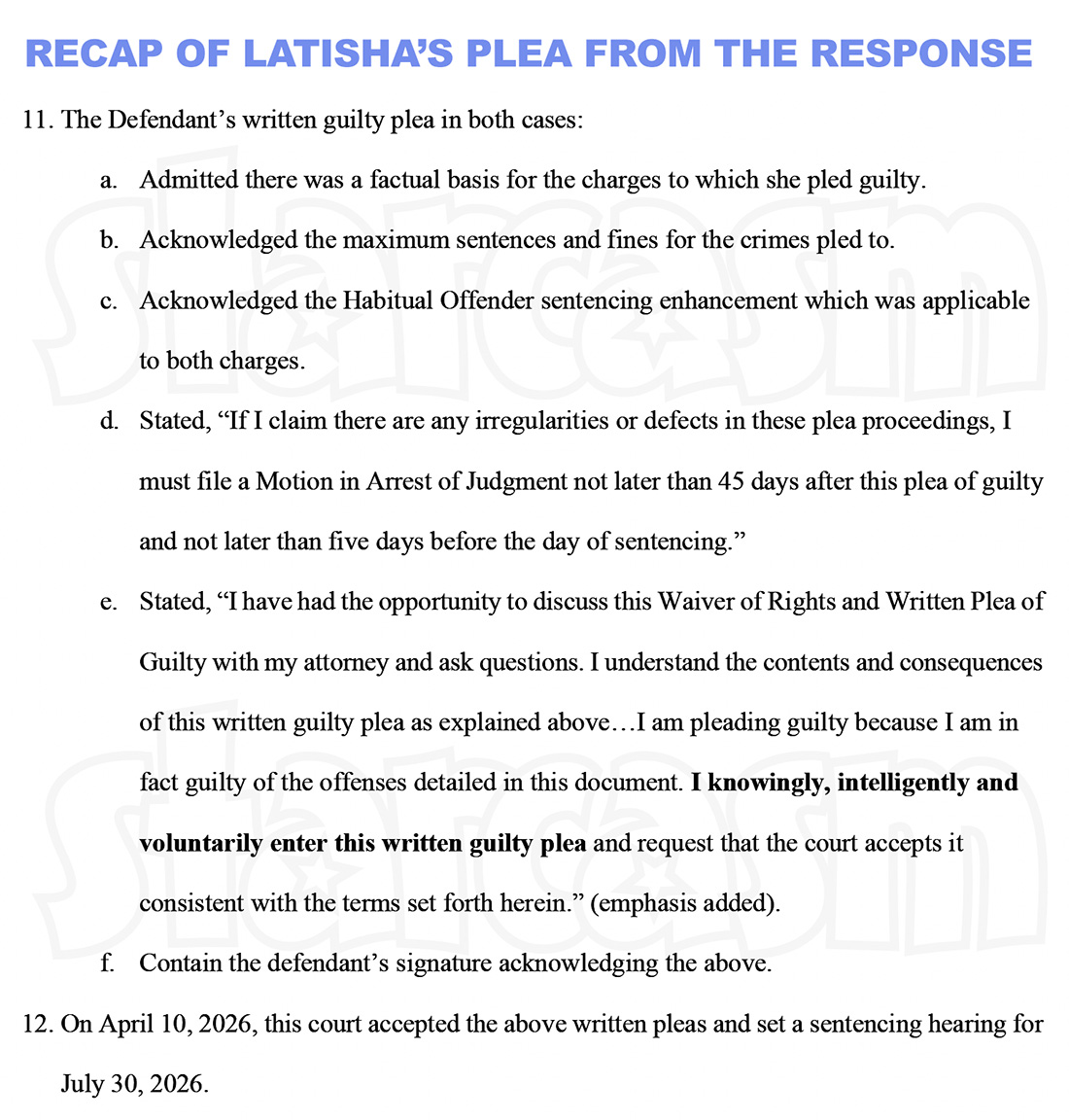
Prosecutors Respond to LATISHA’S MOTION TO REJECT PLEA AGREEMENT
An assistant county attorney filed a response Thursday to LaTisha’s motion in arrest of judgment. The response lays out the criteria for having a plea deal withdrawn, then clearly points out why LaTisha does not meet any of those criteria.
In Iowa, a defendant has the right to withdraw a guilty plea if there are deficiencies in the plea, there is good cause, or it is in the interest of justice.
Regarding potential flaws in LaTisha’s plea:
The defendant pleaded guilty to two Class D felonies. As such, the defendant, with the court’s consent, entered written guilty pleas pursuant to Iowa Rule of Criminal Procedure 2.8(4). The written pleadings provide a factual basis for the crimes pleaded and indicate that the plea is made knowingly, intelligently and voluntarily. The pleadings substantially comply with Rule 2.8(4) and there are no deficiencies in the written pleadings signed by the defendant on 10 April. Therefore, the defendant should not be allowed to withdraw the guilty pleas under Rule 2.24(3).
If there was a defect in the plea, Iowa precedent says that the withdrawal could be denied if the plea agreement would have been “more likely than not” entered into even if there was no defect.
The defendant’s statements in the proposal are best characterized as ambivalent. Statements such as “I struggle with whether I would have made a different decision if I had completely separated the timeline mentally” and “I feel that I may not have fully evaluated my trial options separately for each case” cannot in any way be mistaken for conclusive.
Defendant does not argue that she would not have pleaded if she had known which case was pending. At best, they characterize a general restraint in the case management strategy. Ultimately, the affidavits do not show that the defendant would not have pleaded guilty had the deficiency not arisen under the applicable “more likely than not” standard.
#LoveAfterLockup LaTisha Collier filed a motion today to try to withdraw her guilty pleas that were part of a plea deal in April 🤦🏻♀️
All details: https://t.co/X04Z2D31lp#LoveUnderLockup #LifeAfterLockup pic.twitter.com/vqKohuAyTf
— Starcasm (@starcasm) 26 May 2026
What about LaTisha’s claim that she signed the plea because she felt pressured by a looming court date?
The defendant’s proposal does not provide good reason to withdraw. The motion alleges that the defendant did not know which case was set for trial the following Monday and that the plea was signed under the pressure of the impending trial.
The claims are immaterial because the case is set for a full month in advance on March 13, and the defendant appeared at the final pretrial conference on April 8 to meet with his attorney regarding both cases. The pleadings were not signed until April 10, indicating that another meeting between the defendant and her attorney had taken place. The timeline strongly suggests that the defendant knowingly and voluntarily signed the written guilty pleas.
In addition, the plea (as well as the earlier offer) was made with the understanding that both cases would be resolved together. The defendant would not be able to choose for himself which case he should take to court. This negates the defendant’s claims of having the ability to “pursue forgery/identity theft cases later.”
The defendant’s allegations are self-serving and made over a month after the filing of the guilty pleas for both cases. Therefore, the court should find that there is no good reason to allow the defendant to withdraw his guilty pleas.
Allowing the withdrawal of guilty pleas made close to a trial date because of “the pressure of pending litigation” would weaponize guilty pleas. Defendants on the threshold of trial could plead guilty and then withdraw their guilty pleas at will to delay their trials. The State and its witnesses would suffer great prejudice because delays could result in witnesses becoming unavailable (moving out of jurisdiction, death, etc.) or digital evidence being accidentally deleted.
Granting a motion like the defendant’s would empower any defendant facing an impending trial where a conviction appears to delay their trial and hope for better prospects at a later trial. As such, it would not be in the interest of justice to grant a motion to withdraw and should be denied.
A hearing is scheduled for next week to consider Latisha’s proposal. If denied, her sentencing is scheduled for late July.
#LoveAfterLockup LaTisha Collier filed a motion today to try to withdraw her guilty pleas that were part of a plea deal in April 🤦🏻♀️
All details: https://t.co/X04Z2D31lp#LoveUnderLockup #LifeAfterLockup pic.twitter.com/vqKohuAyTf
— Starcasm (@starcasm) 26 May 2026
Asa Hawks is a writer and editor for Starcasm. You can contact Asa via Twitter, Facebookor email at starcasmtips(at)yahoo.com
Related