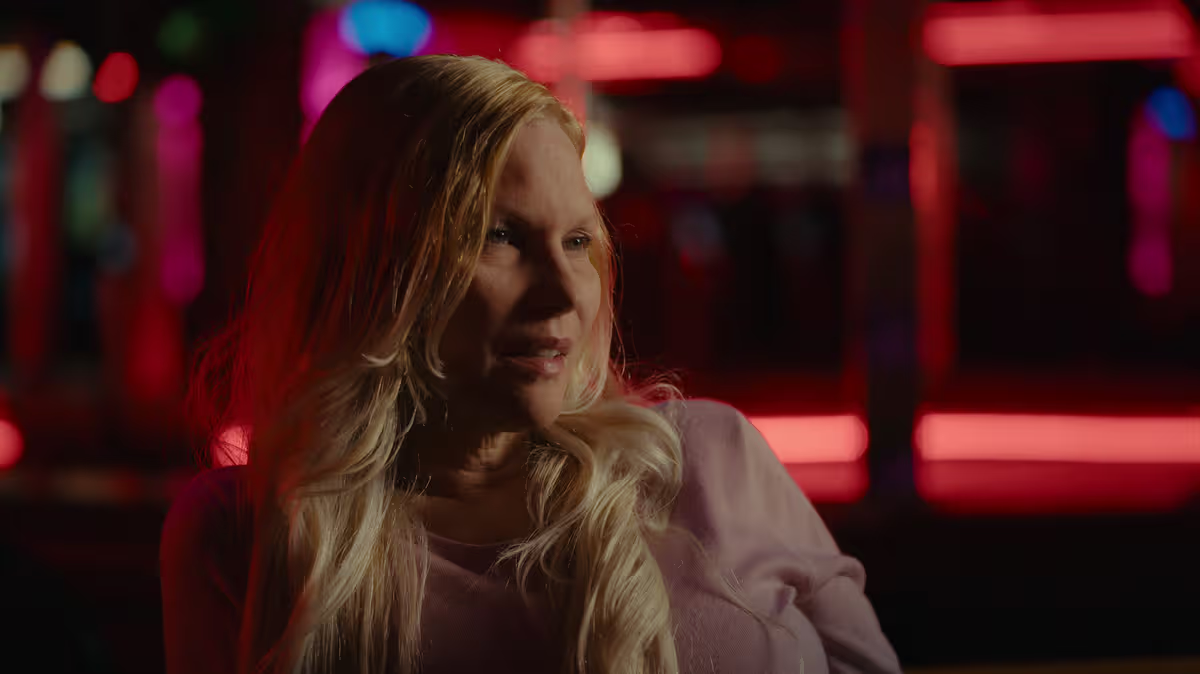

Jelly Roll and Bunny Xo are finished. After Bunnie publicly said they had “been through hell,” after she named the infidelity out loud, after years of what looked like one of country music’s most ride-or-die love stories, the marriage is ending.
And the footage is already flying. She forgave him too quickly. He never really changed. She should have left years ago. He should have begged harder.
I want to slow it down. Because I’ve sat with a lot of couples who looked exactly like that from the outside. Public reconciliation. Public devotion. Tattoos, texts, anniversary posts. And then quietly filed for divorce three or five years later.
There’s a reason “we got over it” so often doesn’t hold up. And it has almost nothing to do with whether the love was real.
The third person who never quite leaves
An affair, in attachment terms, is not just a behavior. It is the introduction of a third party in the primary bond. And the primary bond is based on two beliefs your nervous system needs to feel safe: I am your priority. I am enough for you.
An affair tells your partner’s body in one fell swoop that it is both of these things. It is not housing. It’s a body scan for danger.
People also misunderstand the size of the wound. They believe that an affair is one betrayal. It almost never is. There is the affair itself, and then there are six or seven sub-damages living inside it. You lied to my face. You made me feel stupid. You took her to the restaurant we said was ours. You said you loved me in one night, now I know you wrote to her. You had a whole life I wasn’t in.
On top of that, the betrayed partner loses his grip on reality. They look back at the last holiday, the last anniversary, the last “I love you” and they can’t tell what was real. It’s a kind of dizziness.
Now add the cruelest part. The person they perceive as the one who hurt them is also the person they long to be comforted by. It’s really crazy and it’s the room Jelly Roll and Bunnie lived in, the same room I see couples sitting in every week.
The loop that eats marriages three years later
Here’s the dynamic I see destroying couples who “did the work.”
They come to me two, three, sometimes five years after the affair. They stayed. They are “fine”. They post again. And then every few weeks, a blowout. He is late. He angles his phone. She is right back in the trauma, asking the questions again, voice rising.
He sighs. He collapses. He’s like, “Oh my god, are we doing this again? I’ve apologized a thousand times.”
She explodes.
I call this the “Never Forget, Never Forgiven” loop. And that is the silent killer of marriages after an affair. From the outside, the eye roll looks like a man who doesn’t care. Lower the tape and I see a man who is terrified. His nervous system doesn’t hear, “I need reassurance.” It’s hearing, “You’re bad. You’ll always be bad. No matter what you do, you’ll never be free of this.”
The eye roll is not arrogance. It is despair. It is the breakdown of someone who feels they are serving a life sentence in their own marriage.
If you want to know if you and your partner are in a loop like this, get your free relationship assessment. Sometimes the pattern is easier to see when someone names it for you.
Why shame is the real marriage killer
The biggest obstacle to mending after an affair is not a lack of love. It’s a shame.
The partner who has strayed often drowns. They look at their partner’s tears and it confirms their worst fears for themselves. I’m a monster. I am destructive. I am unworthy. So when their partner starts crying, or asks again, they collapse inwardly. “I can’t talk about this, I’m such a piece of shh.”
That collapse is a disaster. Because when you fold into “I’m bad,” you make the moment about you. You leave your partner in their pain another time. They are left alone in the explosion while you drown in the guilt of lighting the fuse.
Meanwhile, the betrayed partner tries not to punish. She checks. Are you still here? Do you still get it? Is it safe? As he turns away, her certainty evaporates, making her taller. She needs him to feel her pain so she knows she’s not crazy. This is classic attachment traumaand the protest behavior of both parties guarantees that neither will be met.
What looks better in my office is not “communicating more.” It is specific.
First you close the door. Full out. No ambiguity about the third party. You cannot operate while the patient is still bleeding.
Second, you pause the “we both contributed” frame. During a season, traffic flows one way. Someone threw the bomb. The other stood in the explosion. Asking the betrayed partner to “own their part” too soon feels like gaslighting, because it is.
Third, the traitor must change the internal mix. Right now their cocktail is 100% “I feel terrible about myself.” It needs to be 20% “I feel terrible about myself” and 80% “my partner’s heart is broken and I want to stay present with it without cringing.”
The third move is what breaks the loop. And that’s the step most couples never quite learn to take.
The line I wish I could have told them years ago
I don’t know Jelly Roll and Bunnie. I won’t pretend that. But I’ve seen this kind of ending a hundred times, and it’s almost never that the love wasn’t real. It’s that the loop got too tired to keep running.
Forgiveness is not a finish line you cross once. It’s an attitude two people have to keep choosing, on a Tuesday when no one’s watching when she pops the question again and he has to decide what to do with his face.
______________________________________________________________________________________________________
Figs O’Sullivan, the founder of Empathy and his wife, Teal, are couples therapists in San Francisco, relationship experts to the Stars and Silicon Valley, founders of Empathy and built Figlet, our AI relationship coachan AI relationship coach trained in their clinical work.*